
2027 WFEO Hackathon
CHALLENGE 4
Resilient Urban and Territorial Transport Systems
Build mobility systems that keep moving through shocks and stresses
Submit your solution3,000+ engineers. 41 countries. 9 million annual engagements. One global challenge. Now it's your turn.
Engineering responses to advance SDG 11: Sustainable Cities and Communities
Transport networks are the circulatory system of cities and regions – and like any critical system, their failure has cascading consequences. In Hong Kong, public transport accommodates 90% of all daily passenger trips; researchers have warned that a significant disruption to this network could trigger cascading impacts across the city's economy, public health and security. Similar dependencies exist in cities worldwide, where a single flooded underpass, an overloaded grid, or an extreme heat event can paralyze mobility for millions.
Climate change is intensifying these stresses. Case studies from the UK, South Africa, Mexico and the United States show that climate-induced disruptions to public transport predominantly expose weaknesses in infrastructure, while institutional capacity and maintenance investment make the difference between a system that recovers quickly and one that does not. At the same time, rapid urbanization continues to add new demand to transport networks that, in many regions, were never designed for it. Resilient transport engineering is about designing systems that do not just function under ideal conditions, but continue to serve people – or recover quickly – when conditions are not ideal at all.
Submit your solutionThe Challenge
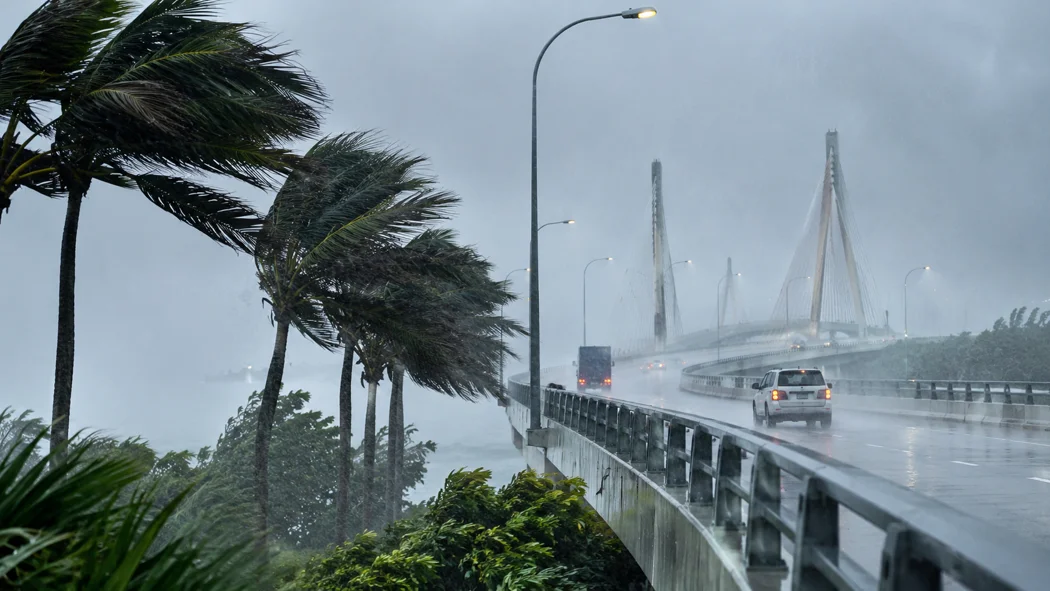
What happens to your city's transport system when something goes wrong – a flood, a heat wave, a power outage, a sudden surge in demand? Explore the resilience of a transport network you know, and propose engineering solutions that help it withstand, adapt to, and recover from chronic stresses and acute shocks.
Engineering Responses and Outcomes
Engineering across multiple disciplines is essential to address this challenge.
Civil and structural engineers
can design transport infrastructure – bridges, tunnels, stations, depots – to withstand extreme weather events and recover quickly when damage occurs.
Transport and systems engineers
can design multimodal, interconnected networks where if one mode or route fails, others can absorb the demand, applying the same “Safe-to-Fail” logic now studied in cities such as Hong Kong.
Climate and environmental engineers
can integrate climate-adaptive design – shaded walkways, heat-resistant materials, flood-resilient drainage – into transport infrastructure serving extreme climates.
Electrical and mechanical engineers
can adapt electrified fleets, such as buses and trains, to perform reliably in extreme heat or cold, as demonstrated by cold-climate electric bus planning in Quebec City.
Data and resilience engineers
can build early-warning and monitoring systems that detect emerging disruptions and support rapid, coordinated emergency response.
Practical engineering solutions
Participants are encouraged to explore affordable flood sensors, bridge and road monitoring, predictive maintenance, community-based early-warning systems, and rapid infrastructure assessment after disasters. Solutions should be practical and affordable for areas with limited resources.
Each participating team is expected to submit the following three engineering outputs:
Technical Design A clear engineering design showing how the solution works and its main components.
Feasibility Study A study covering technical feasibility, estimated costs, maintenance, and practical implementation.
Small Prototype A simple physical or digital model showing how the proposed solution works.
Evaluation Criteria
Projects will be evaluated based on the following criteria:
Innovation and Creativity 15%
Engineering Design and Technical Quality 20%
Technical Feasibility and Practical Implementation 20%
Affordability and Sustainability 15%
Inclusiveness, Scalability and Societal Impact 20%
Prototype Functionality and Demonstration 10%
NB: All projects will be evaluated using the same criteria and scoring system to ensure fairness across the four challenges. Judges will consider innovation, engineering quality, feasibility, affordability, sustainability, inclusiveness, scalability, and measurable impact.
Innovation Examples
Some examples of engineering innovations strengthening the resilience of urban and territorial transport systems.
Interconnected and multimodal resilience
Multimodal network resilience study, Hong Kong – research demonstrating that highly interconnected public transport networks – combining metro, bus, tram and active travel – are significantly more resilient to disruption.
4R resilience framework case studies (UK, South Africa, Mexico, USA) – a comparative study applying robustness, redundancy, resourcefulness and rapidity criteria to assess and improve transit resilience under climate and pandemic shocks.
Climate-adapted infrastructure and fleets
Transit-Oriented Development with climate-resilient design, GCC cities – urban transport planning integrating shaded walkways, cooling infrastructure and compact city design adapted to extreme heat.
Cold-climate electric bus fleet planning, Quebec City (Canada) – a simulation-based framework ensuring reliable electric bus service through harsh winter conditions, balancing charging strategy against energy demand.
Integrated sustainable and resilient mobility planning
Multidimensional sustainable transport strategy, Jeddah (Saudi Arabia) – a transport modernization approach combining green public transport, transit-oriented development and climate-adapted infrastructure.
Deep Dive
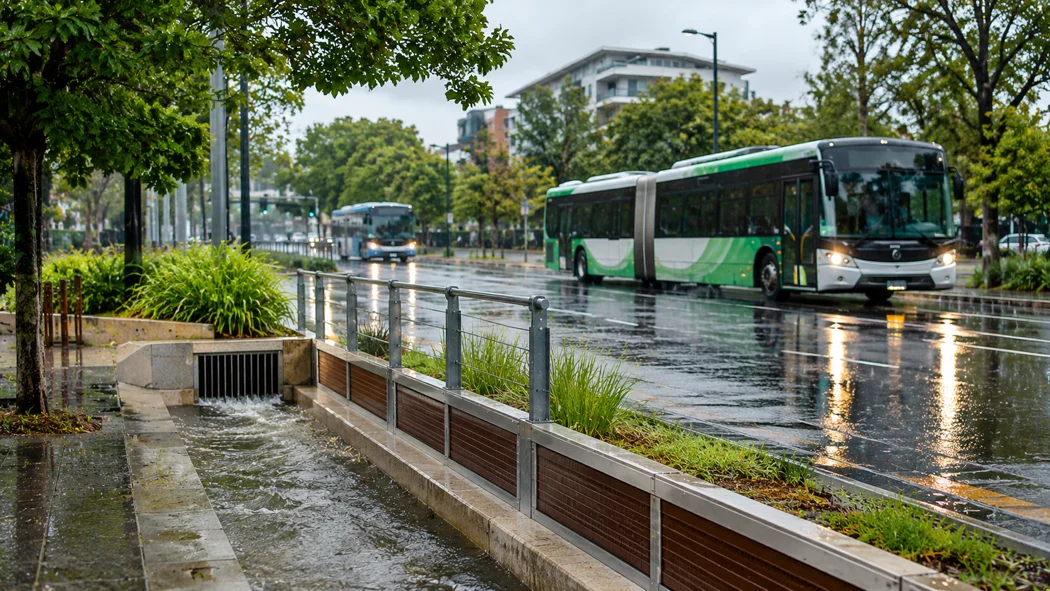
A resilient transport system is one able to withstand, adapt to and recover from both chronic stresses – such as aging infrastructure or rapid urbanization – and acute shocks, such as floods, heat waves or pandemics, while continuing to serve the people who depend on it. Resilience is often assessed using a 4R framework: robustness (the ability to withstand disruption), redundancy (the availability of backup capacity or routes), resourcefulness (the capacity to mobilize resources and adapt) and rapidity (the speed of recovery). Crucially, resilience is not only a property of physical infrastructure. A network can remain physically intact and still collapse functionally if institutions cannot coordinate a response, or if a disruption such as a pandemic changes travel behavior faster than the system can adapt. Engineering resilient transport therefore means designing for redundancy and recovery as deliberately as for everyday efficiency.
Key Issues
Climate exposure of transport infrastructure
Climate-induced disruptions to public transport predominantly expose infrastructural weaknesses, according to comparative case studies across the UK, South Africa, Mexico and the United States.
Sustained investment in resilient infrastructure has proven decisive in limiting disruption, while inadequate maintenance has been shown to significantly worsen outcomes in lower-resourced systems.
Interconnection and cascading failure
In cities heavily reliant on a single dominant mode – such as Hong Kong, where public transport carries 90% of daily trips – disruption can cascade rapidly across the wider economy and public health system.
Research shows that increasing the interconnectedness of multimodal networks measurably improves their tolerance to disruption, supporting “Safe-to-Fail” urban mobility design.
Rapid urbanization and rising demand
Continued global urbanization is adding new demand to transport networks, many of which were not designed for current population levels, let alone projected future growth.
Transit-oriented development and compact city planning are increasingly used to reduce travel distances and build resilience directly into urban form.
Institutional capacity and governance
Effective resilience depends as much on institutional coordination, early-warning systems and emergency response protocols as on physical engineering.
Resilient transport systems must adapt not only to climate threats but to broader shocks – including pandemics – which challenge the operational flexibility of services as much as their physical infrastructure.
Additional Resources
KEY DATES
- - Registrations open
- - Challenges released
- - Submissions due
- - Winners announced
WHAT DO YOU NEED TO SUBMIT?
The 2027 WFEO Hackathon has a single submission round, giving teams three weeks to develop and submit their solution.
They must submit a 5-minute video, team photo and written submission.
Written submissions must be in English.
Videos may be recorded in another language but must include English subtitles.
Read the submission requirements on Zealous.
PRIZES
€7,000 IN PRIZE MONEY
FIRST PLACE
€4,000
SECOND PLACE
€2,000
THIRD PLACE
€1,000
Prizes will be split evenly between the members of each winning team.
FAQs
How do we upload our submission?
Upload your entry through the WFEO Hackathon submission page on Zealous.
Do I have to be a university student to participate?
No. The Hackathon is primarily for engineering students and young engineers under 30.
Can high school students or participants under 18 take part in the WFEO Hackathon?
Yes. High school students and other participants under the age of 18 may participate in the WFEO Hackathon as team members, provided they have the consent of a parent or legal guardian.
Participants under 18 will be required to submit a parental/guardian consent form during the application process.
Teams including participants under 18 must be led by an eligible engineering student or young engineer under the age of 30.
Does everyone have to be from the same university or institution?
No. Teams can include participants from different universities, institutions and locations.
Is there any cost to participate?
No. The 2027 WFEO Hackathon is completely free to enter.
When will we receive the Challenges?
The official Challenges will be released on 20 November 2026, marking the beginning of the three-week Hackathon period.
How many participants can be in a team?
Teams consist of 3 to 5 participants and must be led by a young engineer or an engineering student.
Multidisciplinary teams are encouraged but must be led by a young engineer or an engineering student.
What can you tell us about the Challenges?
The Challenges will focus on real-world issues where engineering can contribute to Sustainable Transport and the United Nations Sustainable Development Goals. The official Challenges remain confidential until 20 November 2026.
Do I need a team before I register?
No. Register individually and use our Facebook group to connect with potential teammates.
Can my team include people from different countries?
Yes. Teams can collaborate across universities, institutions, disciplines and countries.
Can we use AI in our submission?
Yes. AI tools can assist with your submission, including creating visualizations.
However, AI must not mislead or misrepresent the potential or feasibility of your solution, including through unrealistic visualizations or false deepfake endorsements.
Who owns the intellectual property for our solution?
Entrants retain ownership of their designs. By participating, entrants give WFEO permission to use and modify submitted photographs, videos and written content to promote current and future Hackathons.
Can we use copyrighted material?
Teams should use original material wherever possible. Music, stock footage and other third-party content must be copyright-free or appropriately licensed.
Who should I contact with a Hackathon query?
Please email the WFEO Hackathon team at wed@wfeo.org.